02 b Recharla and devarakonda velamas
>[!example ] Singama Act Seriously in Assistant Commissioner Post
>- S - singama nayaka I
>- A = Anapota I
>- Singama Nayaka II
>- Anapota - II
RECHARLA &
DEVARAKONDA VELAMAS
?
- from the chat gpt
- Some inconsistencies in the origin of Recherla formation
You drank 2 rasna with with and slept on the sea floor
- sea floor - Singama nayaka II
- drank 2 rasnas
- Rasam thaganu appudu dhigindhi
- Rasam - Ratna panchalika
Singama Nayaka-I (AD 1325-1361)
?
Singama Act Seriously in Assistant Commissioner Post
- S - singama nayaka I
- A = Anapota I
- Singama Nayaka II
- Anapota - II
- Singama Nayaka I's rule commenced in turbulent times, with the over- throw of Tughlaq authority.
- Thereafter, while Musunuri Kapaya Nayaka was engaged in battle with the Bahmanis, Singama Nayaka I used the oppurtunity to extend his kingdom as far as Eleswaram on the banks of the Krishna and seized some of the forts in the doab between the Krishna and the Tungabhadra.
- He also came into conflict with the Chalukya princes who sought help from the Reddis of Kondavidu in order to stop his aggressive attack.
- Undaunted, Singama Nayaka I proceeded with a huge army and seized the fort of Jallipalli near Khammam which was under the control of the Chalukya princes who, during the course of the ongoing battles, had imprisoned his brother-in-law Chintapalli Singama Nayaka there.
- To free Chintapalli, Singama carried out a vigorous attack on the fort of Jallipaili.
- The Chalukya princes lost all hope of success. Unable to hold the fort, they resorted to treachery and had Singama Nayaka I assassinated by one Tambala Bammajiyya.
- However this did not put paid to their troubles, because his descendants, enraged at the news of their father's assassination, seized the fort and massacred all the Kshatriyas and their allies lodged in the fort in AD 1361.
Anapota I (AD 1361-1383) and Mada I (AD 1361-1384)
?
Singama Act Seriously in Assistant Commissioner Post
- S - singama nayaka I
- A = Anapota I
- Singama Nayaka II
- Anapota - II
-
-
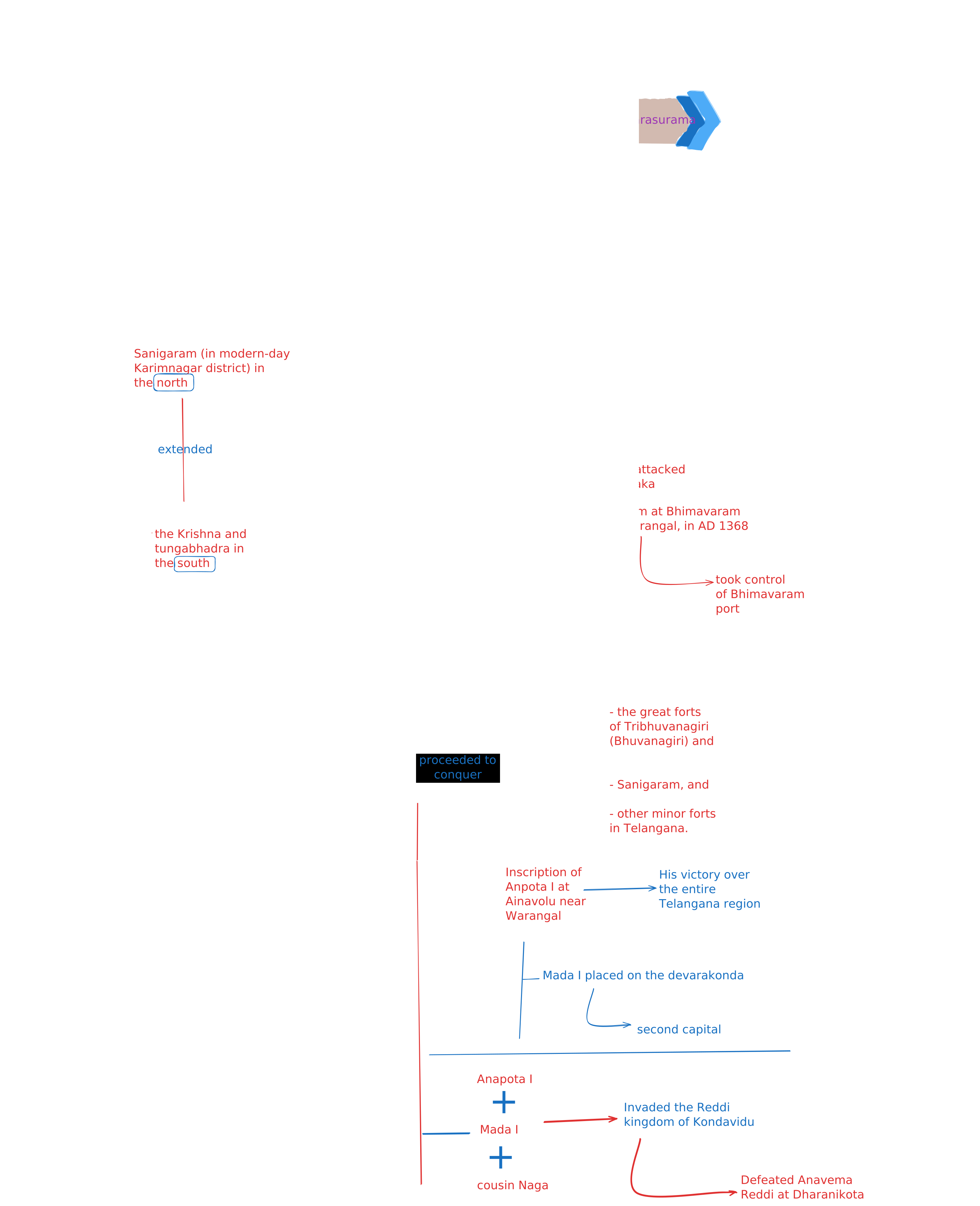
Thereafter, Anapota I and Mada I, along with their cousin Naga, son of Yachama Nayaka, invaded the Reddi kingdom of Kondavidu. The Velugotivari Vamsavali states that Mada Nayaka and Anapota Nayaka defeated Anavema Reddi of Kondavidu at Dharanikota. The clash resulted in Anapota I and Mada I crossing the river Krishna and conquering the region to the south of the Krishna (areas in the modern-day Kurnool) and Guntur districts).
- So parts of the Reddi kingdom on the southern banks of the Krishna, particularly around Srisailam (now in Kurnool district), were annexed to the Recherla kingdom, as corroborated by epigraphical evidence as well.
- The Rasarnava Sudhakaram states that Mada I constructed a flight of steps to the sacred mountain of Sriparvatam and made it accessible to pilgrims from Telangana.
- This indicates that Sriparvatam was part of their kingdom. This is also supported by an inscription of Mada I at Jatararevu near Srisailam, which states that the steps were constructed for the convenience of pilgrims who came from Telangana.
- The rule of the two brothers witnessed the climax of Recherla power in Andhradesa.
- By AD 1384 the kingdom extended over territories to the south of Devarakonda.
- The inscription of Mada I at Umamaheswaram states that his rule extended over the land lying between Srisailam and the Vindhya mountains.
- The inscription of Anapota at Simhachalam indicates that the coastal campaigns of the Recherlas went up to Simhachalam. However, they could not annex any part of coastal Andhra.
- Prior to the extension of Bahmani rule into Telangana, it was under the control of the Recherlas.
Singama Nayaka II (AD 1383-1399) and Vedagiri | (AD 1384-1410)
?
Singama Act Seriously in Assistant Commissioner Post
- S - singama nayaka I
- A = Anapota I
- Singama Nayaka II
- Anapota - II
Anapota II (AD 1399-1425), Rao Madaned Mada Nayaka-l.
?
Singama Act Seriously in Assistant Commissioner Post
- S - singama nayaka I
- A = Anapota I
- Singama Nayaka II
- Anapota - II
- anapota II and Rao Madaned Mada Nayak I excalidraw

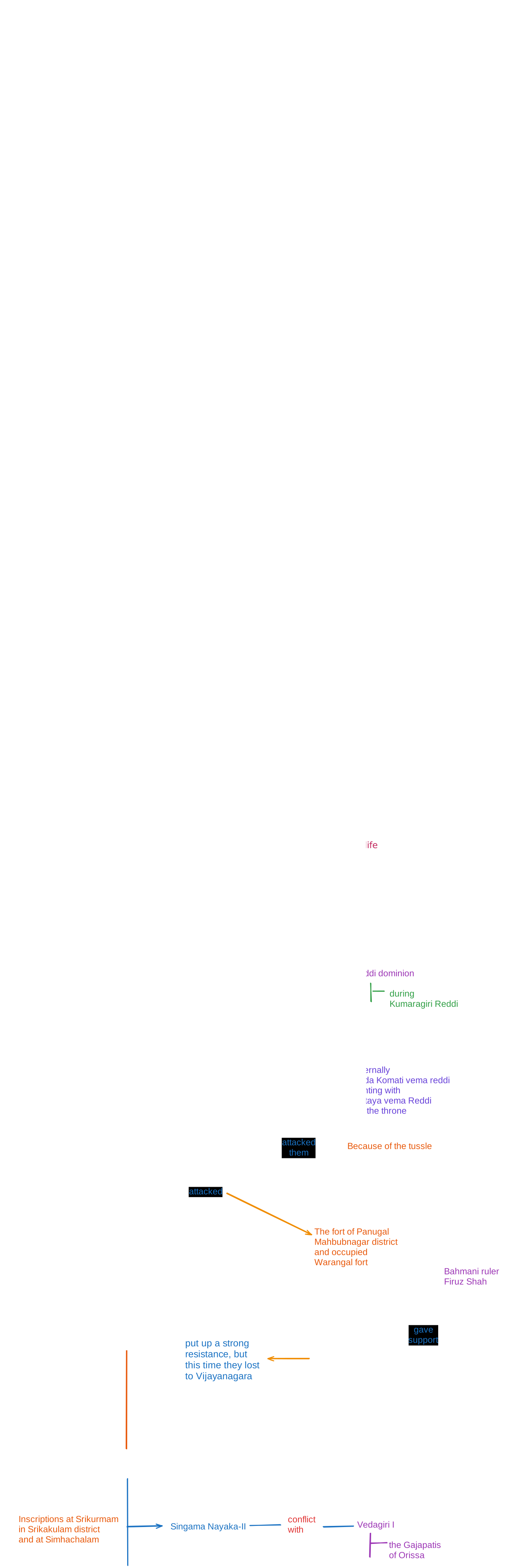
- In AD 1399, Singama Nayaka II was succeeded by his sons Anapota II and Rao Madanedu, and at the same time Mada Nayaka II succeeded his father Vedagiri I at Devarakonda.
- Their reigns witnessed a series of wars with the Reddis and the Vijayanagara Rayas, and finally with the Bahmanis.
- They provoked a conflict with the Reddis of Rajahmundry by offering asylum to Annadeva Choda, a chief in the lower Godavari belt who had been driven out of his dominions by the Reddis of Rajamahendravaram.
- Madanedu of Devarakonda defeated the Reddis and annexed Annadeva Choda's dominion.
- But within no time Peda Komati Vema Reddi, with the help of the Bahmanis, restored the lost territory to Annadeva Choda.
- The Bahmani army led by Sultan Feruz Shah attacked Panugal fort.
- This time Singama Nayaka and Vijayanagara joined together, marched their combined army against the Bahmanis and defeated them. In the battle, in AD 1419, Macha Reddi, brother of Pedakomati Vema Reddi, was assassinated.
- Immediately after this, to take revenge on the Recherlas, Peda Komati Vema Reddi attacked Devarakonda and killed Pina Vedagiri.
- Soon after this incident, in AD 1420, the Velamas killed Peda Komati Vema Reddi and hanged him at the entrance of the fort of Devarakonda.
- After this war the Reddi kingdom of Kondavidu virtually disappeared from the political scenario of Andhra.
- After Anapota II, his brother Rao Madanedu ascended the throne as regent at Rachakonda because Anapota's son Singama Nayaka III was too young to be king.
- Rao Madaned and his brothers Dacha, Vallabhanedu, Vedagiri and Damanedu, helped the young king in times of war and in the daily administration of the kingdom.
- Rao Madanayaka, younger brother of Anapota II, or Kumara Anapota ascended the throne at Rachakonda in AD 1423.
- In AD 1425 Anapota I was succeeded by his son Singama Nayaka III (AD 1425 - 1475), and Mada Il was succeeded by his son Vedagiri II (AD 1425- 1475) at Devarakonda.
- During this period the kingdom of Rachakonda witnessed decline.
- The Bahmanis of Bidar occupied the forts of Medak, Warangal and Bhuvanagiri during AD 1433 - 38
- What happened to Singama Nayaka-III subsequently is not known. He probably retired to Bellamkonda in Guntur district, where he appears to have led an eventful life till AD 1455.
- Except for Devarakonda, therest of the Recherla Velama kingdom was subjugated by the Bahmanis.
- Singama Nayaka, unable to resist the Bahmani attacks, sought the help of the Orissa rulers.
- Taking advantage of the Velamas weakness, Kapilesvara Gajapati of Orissa readily accepted the request of Linga and sent a large force to Devarakonda against the Bahmanis.
- Linga Nayaka reoccupied his lost territories such as Orugallu and Bhuvanagiri in AD 1461, and became a vassal of the Gajapatis of Orissa on account of the help they gave him to defeat the forces of the Bahmanis.
- The inscriptions of Kapilesvara Gajapati of Orissa reveal the same information. Rao Dharma Rao, son of Linga Nayaka, was appointed to rule over Orugallu or Warangal.
- The integrity of the kingdom of Rachakonda and Devarakonda came to an end in the last years of Linga Nayaka.
- At the time of the death of Kapilesvara Gajapati in AD 1470, conflicts arose between his sons Purushotama Gajapati and Kumara Hamvira Gajapati for the throne.
- Taking advantage, the Bahmani sultan Muhammad Shah II defeated Linga Nayaka and occupied Rachakonda and Devarakonda.
- After Linga Nayaka, his brother Suranedu, son Parvata Rao and grandson Linga Nayaka II ruled over Devarakonda for some time as subordinates of the Bahmanis, paying them some annual tribute; later on they came under the yoke of Vijayanagara.
%%{ init: { 'theme': 'base', 'themeVariables': { 'primaryColor': '#EFEFEF', 'fontSize': '25px', 'primaryTextColor': '#0f766e', 'primaryBorderColor': '#7C0000', 'lineColor': '#F8B229', 'secondaryColor': '#EFEFEF', 'tertiaryColor': '#fff' } } }%%
flowchart TD
    A(["**Anapota Nayaka 1361-84**"]) --> n16["one"]
    n3["Battles with"] --> n4["Reddis of kondaveedu"] & n5["Vijayanagra rulers"]
    n4 --> n6["Conqured"]
    n5 --> n6
    n6 --> n7["fort of warangal"] & n8["Fort of medak"] & n9["forto of Golconda"]
    n2["velama kingdom splis into two kingdoms"] --> n10["North part"] & n11["south part"]
    n11 --> n12["Madava nayaka"]
    n10 --> n13["Anapota"]
    n13 -- capital --> n14["Rachakonda"]
    n12 -- capital --> n15["Devarakonda"]
    B("Killed kapanayaka") --> A
    n16 --> n17["follow on"] & n3
    n17 --> n2
    n13 -- brother of anapota --> n12
    n2@{ shape: proc}
     A:::Aqua
     n3:::Rose
     n6:::Pine
    classDef Rose stroke-width:1px, stroke-dasharray:none, stroke:#FF5978, fill:#FFDFE5, color:#8E2236
    classDef Pine stroke-width:1px, stroke-dasharray:none, stroke:#254336, fill:#27654A, color:#FFFFFF
    classDef Aqua stroke-width:1px, stroke-dasharray:none, stroke:#46EDC8, fill:#DEFFF8, color:#378E7A
    linkStyle 13 stroke:#000000,fill:none