01 satavahana
>[!hint ] SK Sentenced to Prison for Sex in KPH Got Very Sexy Young Prostitute
>- S - Simukha
>- K - Kanha (krishna)
>- S - Satakarani
>- P - Purnotsanga
>- S -Satakarani II
>- K - Kunatala Satakarani
>- P - Pulomavi-I
>- H - Hala
>- G - Gautami Putra satakarani
>- V - vashistaputra pulomavi
>- S - Sivasri Satakarani
>- Y - Yagnasri Shatakarani (gautamiputra yagnasri)
>- P - Pulomavi - III
SATHAVAHANAS
- SATHAVAHANAS ⟶ Dynasty Founder {{Sathavahana}}
- SATHAVAHANAS ⟶ Kingdom Founder {{Sri Muka}}
- SATHAVAHANAS ⟶ Capitals - {{Dhaanyakatakam }}(Amaravathi), - {{Paithan (Prathishtanapuram}})
- SATHAVAHANAS ⟶ Great Ruler {{Gautami Putra Satakarni}}
- SATHAVAHANAS ⟶ Last Ruler {{Pulamvai-III}}
- SATHAVAHANAS ⟶ Official Language {{Prakrith}}
- SATHAVAHANAS ⟶ Religions {{Hindusim & Jainism}}
- SATHAVAHANAS ⟶ Foreign Traveler {{Megasthenese}}
Importance:
- The Satavahanas are the first historical ruling dynasty of the Deccan whose achievements in the politics, religion, literature and art are remarkable.
- Their long period of rule extending over five centuries is unique in many ways.
- They were the only South Indian Dynasty to control the entire Deccan and extend their way over Magadha for sometime.
- Further, they saved the Dakshinapatha from the onslaught of the foreign invaders who, in the opening years of Christian Era, entered Aryavarta from the north-west and wrought havoc in North India.
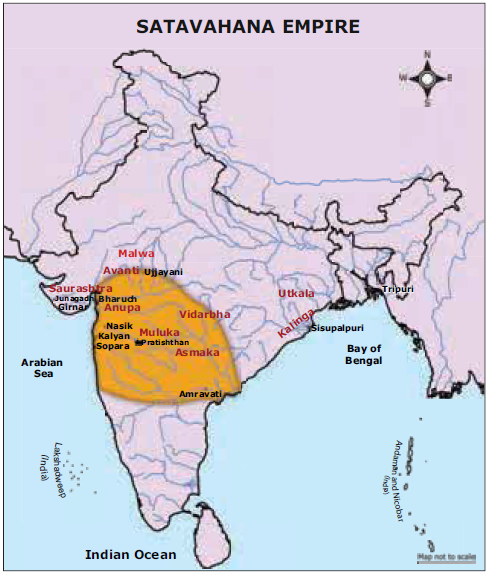
- The Satavahana Empire which give peace and stability to the Deccan for about five hundred years as its Zenith included not only the present Andhra Pradesh, but also parts of Maharashtra, Gujarat, Madhya Pradesh, Orissa, Bihar, Karnataka and Tamilnadu.
Inscriptions:
?
- Satavahana inscriptions are scattered between Sanchi (Madhya Pradesh) in the north and Bellary (Karnataka) in the south and Kanheri Maharashtra in the west and Amaravati (Andhra Pradesh) in the east.
- Most of the inscriptions are private votive records registering in the deeds of religious charity like excavation of a cave of setting up a pillar for a chaitya.
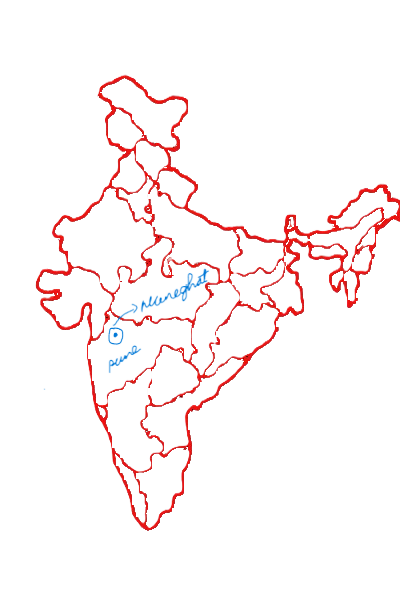
- Some of the inscriptions found in the caves of Naneghat, Kanheri, Nasik and Karla in Maharashtra and in Guntupalli and other places of Andhra of historical value as they contain the names of reigning sovereigns and mention their regnal years.
The Naneghat inscription of Naganika:
?
- One of the inscriptions in the caves of Naneghat was inscribed by Naganika, the wife of Satakarni-I after the death of her husband.
- From the inscription it is evident that Satakarni conquered Western Malwa, Anupa on the Narmada valley and Vidharbha.
- The inscription also states that Satakarni performed the Aswamedha sacrifices and one Rajasuya sacrifice in commemoration of the victories and proclaimed himself Samrat and aimed the title of "Dakshinapathi" and "Aprathi Hatah Chakra".
The Hathigumpha and Guntupalli Inscriptions:
?
- The Hathigumpha and Guntupalli inscriptions of King Kharavela of Kalinga state that the army of the Kalinga ruler reached Kannabenna (river krishna) and threatened Mushikanagara.
- The inscription thus records the conflict between Satakarni -I and Kharavela for the possession of the Godavari and Krishna river basins but doesn't claim any success for the latter.
Nasik Inscription:
?
- The Nasik Inscription of Gautami Balasari lists out the countries conquered by her son Gautamiputra Satakarni.
- The Satavahana inscriptions on Andhra belong to the time of Pulomavi and his successors.
- All the Satavahana inscriptions are in prakrit language and Brahmi script.
Inscriptions
- Naneghat Naganika
- Nasik Gautami Balasri
- Hatigumpa & Gutupalli - Karavela
- Macadoni - Pulamavi-III
- Junegad - Saka Raudradama
- Chinnaganjam - Gautami Putra Yagnasri
- Nasik-2 - Krishna
- Amaravati - Sivamuka Satakarni
Coins:
?
- The Satavahanas struck coins in metal like copper, lead and tin.
- Coins found at a number of places in the Deccan throw a flood of light on the Satavahana history.
- Excavations carried out at places like Kondapur in Medak district and Peddabankur, Dhulikatta and Kotilingala in Karimnagar district yielded a large quantity of coins.
- The outstanding discovery was the coins relating to Simukha, the founder of the Satavahana Kingdom.
- The coins have the legend 'Siri Chimukha Sata' at the top.
- Dr. P. V. Parabrahma Sastry identified Chimukha of these coins with Simukha, the founder of the puranic list of the Satavahana dynasty.
- The coins found at Peddabankur include punch marked Silver, Roman Denare and the various Satavahana rulers.
- Excavations conducted at Dhulikatta or Dhulikota (mud fort) ten kilometers west of Peddabankur brought to light the traces of the walled town of the Satavahana period.
- V.V. Krishna Sastry believes it to be one of the thirty fortified towns of Andhra mentioned by Megasthenes.
- The discovery of the coins of Simukha at Kotilingala strengthens the claim of Telangana as the original home of the Satavahanas.
- At Paithan (Aurangabad district, Maharashtra) or Pratishtanapura, the ancient capital city of the Satavahanas, unique coins containing the portrait of King Satakarni, and also Gajalakshmi type lead coins of the same king are found.
- A silver coin said to be a joint issue of Satakarni and Naganika was published.
- But it's authenticity is questioned by Dr. Ajay Mitra Sastry of Nagpur University.
- However Goutamiputra Satakarni restruck the silver coinage of Nahapana, the Saka king, and also attempted to issue his own silver coinage, but his successor discontinued the practice.
- The coinage of the Satavahanas has attracted the attention of historians like E.J Rapson, Parabrahma Sastri, Krishna Sastri and Ajay Mitra Sastri.
- Rapson's catalogue of Andhra coins is a scholarly publication.
- Coinage of the Satavahanas and coins from excavations edited by Ajay Mitra Sastri is another noteworthy study of Satavahana coins.
Literature:
?
- References to the Satavahanas are found in some of the ancient literary works.
- According to the Matsya and Vayu Puranas, the last Kanva king, Susraman, was killed by the Andhra king, Simukha
- The puranas also contain the list of Andhra or Satavahana kings and their regnal years.
- But the puranic lists are of doubtful value as they are inconsistent and inadequate.
- The katha Saritsagara based on Brihatkatha of Gunadhya gives information about the Satavahana society.
- Gargi Samhita Saptasati, an anthology of verses compiled by Hala, a Satavahana ruler, Kamasutra of Vatsyayana, help us to know the society and religion of the Satavahana period.
- Leelavathi, a Prakrit work of Kutuhala, tells the love story of Hala and Leelavathi, a princess from SriLanka.
- The background of the main scene was Sapta-Godavari Bhima identified with Bhimeshwara temple of Draksrama in East Godavari district.
- The Buddhist works like the Jatakas, the Pitakas, the Mahavastu and the Katharvastu also contain references to the Andhras.
- In the Jain literature there are references to Prathisthana as the capitals of early Satavahana kings.
- Among the foreign works, the Indica of Meghasthenes makes a mention of Andhras and their military might.
- Similarly the Periplus of the Erytherean Sea by an unknown Greek author gives an account of Masolia (Machilipatnam).
- This has been identified with Maisolia, the greatest market of the Andhra kingdom, mentioned by Ptolemy.
The Andhra-Satavahana Controversy :
?
- There has been a controversy for the last one hundred years over the identity of the Satavahanas.
- One group of historians, which include Vincent Smith, E.J.Rapson, L.D Barnett, R.G.Bhandarkar, Maremanda Rama Rao and Gurty Venkata Rao, support the view that the Satavahanas were Andhras.
- This view was opposed by another group of historians like P.T. Srinivasa Iyyangar, V.S. Sukthankar, H.C.Rayachaudari, V.V.Mirashi who regard the Satavahanas as Maharashtrians.
- Those who opposed the Andhra origin of the Satavahanas based their arguments on the following grounds:
- The Andhras of present day occupy the Eastern Deccan while the Satavahana rule commenced in the Western Deccan or Maharashtra.
- Further, the early capital of Satavahanas was Prathisthana or Modern Paithan in the Aurangabad district of Maharashtra.
- The earliest Satavahana records like the Nanaghat inscription of Naganika and the Nasik inscription of Gautami Balasri are in Maharashtra.
- No epigraphical record of the early Satavahana rulers is found in Andhra.
- Only with the reign of Vashisthaputra Pulamovi Satavahana records begin to appear in Andhra.
- Further, in none of the inscriptions do the Satavahanas call them Andhras.
- The language used in the Satavahana inscriptions and coins is prakrit while Telugu is the language of the Andhras.
- The puranas which listed thirty rulers call them Andhras or Andhrabrithyas and not Satavahanas.
- The Satavahanas are popularly referred to as Andhras since the later Satavahana kings who lost their original home in the Western Deccan confined their rule to the Eastern Deccan or Andhra Desa.
- Further, the use of metronymics by the Satavahana rulers show their Maharashtra origin.
- Though the above arguments appear to be strong they do not stand up to historical scrutiny.
- It is true that the Andhras of the present day occupy Eastern Deccan alone, it included the Eastern Deccan and other areas also.
- After the death of Asoka, the Andhras who were second only to the Mauryans in power and glory, extended their authority as far as Nasik in the west.
- At the same time, the Greek and other foreign tribes invaded Aryavarta and threatened the political stability of the Dakshinapatha.
- So the Satavahanas, in order to resist the likely foreign incursions from the north, made Prathisthana their capital, since that city was strategically located on the highway that connected the Dakshinapatha with the north.
- Further, it controlled the passes in the north that connected the mainland of the Deccan with the west coast.
- The association of the Satavahanas with Prathisthana was so shortlived.
- Only the early rulers stayed there. The capital was shifted to the Eastern Deccan or the Andhra region once the danger of the foreign invasion was removed.
- The second argument- that the early records of the Satavahanas have been discovered in Maharashtra alone, no longer holds good.
- Only two inscriptions(Naneghat & Nasik) and a few coins of doubtful authenticity were discovered in Maharashtra.
- But recent excavations in Telangana districts of Andhra Pradesh resulted in the discovery of a large number of Satavahana coins and seals.
- At kotilingala several coins of Simukha, the founder of the Satavahana dynasty, and those of other early kings like Kanha(Krishna) and Satakarni I were found.
- Similarly at Kondapur, Peddabankur, Dhulikatta several seals, coins, terracotta objects were discovered testifying to the fact that the region was an active centre of Satavahana trade and commerce.
- The fact that the coins of Simukha, the founder of the Satavahana kingdom, and those of early kings found in Dhulikatta in Karimnagar district is a positive proof that Telangana was the nucleus of the Satavahana empire.
- Further, the description of Satakarni as Dakshinapathapati in tha Nanaghat inscription proves that the Satavahana Dominian was not confined to Western Deccan alone but included other areas of the Deccan and beyond
- The argument that the Satavahanas did not call themselves Andhras is ridiculous.
- The ruling dynasty refers to itself by the dynastic name or the name of the gotra and not by the name of the people.
- The Ishavakus, Vishnukundins and Kakatiyas who ruled over Andhra after the disintegration of the Satavahana empire also did not call themselves Andhras.
- The third argument that the Satavahanas used Prakrit and not Telugu in their records is not valid for the simple reason that Telugu in its present form developed around the Sixth Century A.D.
- The Satavahanas used Prakrit in their records since it was the official language of the ruling dynasties since the time of Ashoka until about the 3rd century A.D.
- Even the three early Pallava copper plate grants are in Prakrit.
- When Sanskrit regained its pre-eminence under the Gupta's, inscriptions were issued in that language.
- The fourth argument that the list of the Kings in the Puranas are referred to as Andhras Andhrabrithyas (Servants of Andhras) and not Satavahanas actually supports the theory that the Satavahanas actually supports the theory that the Satavahanas were Andhras.
- The names of Andhra kings mentioned in the Puranas are more or less similar to the names that can be derived from the Satavahana inscriptions and coins.
- The common names in both the sources include Simukha, Kanha (Krishna), Satakarni I, Satakarni II, Apalika, Meghasvathi, Gautamiputra, Pulomavi II and III, Sivasri, Chandrasri.
- There could not have been so many similar names if the kings belonged to different families.
- The fact is that the Puranas refer to the Satavahana kings by the name of their race as Andhras, whereas the inscriptions and coins highlight the dynastic name the Satvahanas.
- Moreover, since the Puranic accounts are based on the court records and the oral history of the time, they cannot make a fundamental mistake regarding the racial origin of the ruling family.
- The fifth argument that the Satavahanas are popularly regarded as Andhras because the later kings of the dynasty stayed in Andhradesa after they lost Western Deccan actually strengthens the case that the Satavahanas were Andhras.
- The last argument regarding the use of metronymics by the Satavahanas does not strengthen the case of Maharashtra, since Gautamiputra Satakarni, the 23rd king of the dynasty, and his successors who gradually lost control over the Western Deccan and confined themselves to Andhra started this practice.
Original Home of the Satavahanas :
?
- There is yet another controversy. Scholars do not agree about the original home of the Satavahanas.
- Vincent Smith was of the opinion that the delta basins of the Godavari and Krishna rivers were the home of the Andhras during the time of the Mauryas.
- After the death of Asoka, the Andhras asserted their independence and extended their empire towards Western Deccan.
- This view was accepted by other historians like E.J.Rapson, L.D. Barent, R.G. Bhandarkar, Gurty Venkata Rao and Maremanda Rama Rao.
- The above view was challenged by V.S. Sukthankar who argued that Bellary district of Karnataka was the original Satavahana home.
- He based his argument upon the names Satauahani-hara and Satavahana-ratha used respectively in Myakadoni inscription of Pulomavi III and Hiharadagalli plates of Pallava Sivaskanda Varman, found in Bellary district.
- His argument is controverted by historians like M. Rama Rao who argued that the names Satavahani-hara and Satavahana-ratha indicate that they were ruled by Satavahanas and nothing more.
- There is no evidence of the existence of the early Satavahanas there and Pulomavi Ill was removed from Simukha, his remote ancestor, by thirty-eight generations and more than four hundred years.
- The inscription in question was inscribed on a boulder named Janagaligundu near Myakadoni which is now in the Adoni Taluk of Kurnool district of Andhra Pradesh.
- Historians like P.T. Srinivasa lyyangar rejected the Godavari Krishna basin theory of Vincent Smith on the ground that Telugu was not used in the Satavahana inscripitons.
- As the Prakrit language was used in the Satavahana inscriptions and in Hala's Saptasati, Iyyangar felt that Maharashtra was the original Satavahana home.
- The theory is rejected since the Telugu language did not evolve at the time.
- Further, Prakrit was used not only in the Satavahana records but also in the edicts of Asoka.
- H.C. Rayachaudhari also supported the theory that the Satavahanas were originally from Maharashtra and moved eastwards and conquered Andhra Desa.
- But there is no evidence that the Satavahanas conquered Andhra.
- As a matter of fact that account of Megasthenes shows that the Andhras were a great power even during the time of Asoka.
- After the downfall of the Mauryas, the Andhras expanded their kingdom towards the west and ruled over Maharashtra also.
- Later, when they lost Western Deccan, they returned to their native Andhra Desa.
- V.V. Mirashi argues that Vidharbha was the original home of the Satavahanas on the basis of the Hathigumpha inscription which records that the armies of Kharavela, without heeding Satakarni, proceeded west and reached Kannabenna, threatening Musikanagar.
- As Vidharbha is on the west of Kalinga Mirashi puts forward the claims of the former as the original home of the Satavahanas and identifies Kannabenna with the river Kanhan flowing near Nagpur.
- The theory is defective since the Guntupalli inscription of coastal Andhra.
- Futher traditionally, the northern Coastal Andra districts are called the eastern area by the people south of the Godavari river.
- This is because of the eastward bend of the east coast near the mouth of the Krishna river.
- So the Hathigumpha inscripton's account of Kharavela's invasion towards the west of Kalinga refers to his invasion of the Satavahana kingdom of the south.
- The above theories only prove that the Satavahana rule extended over Western Deccan, Bellay and Vidharbha.
- The recent discovery of Satavahana coins including those of Simukha, the founder of the Satavahana dynasty in Telangana districts of Andhra Pradesh, the evidence of Megasthenes, the testimony of the Puranas prove that the Satavahanas were Andhras.
- Satavahana was the name of the dynasty (Vamsa) which belonged to the Andhra race (lati).
- In the post-Asokan period the Satavahana rule extended over the entire Dakshinapatha for nearly five centuries.
- Karnataka - V.S.Sukthankar
- Vidharba - V.V.SMirashi - Maharashtra
- P.T.Srinivas lyengar & Jogelker
- Andhra - Rapson, Vincent Smith, Bhandarka, Burlen, Gutti Venkata Rao
- Telangana - Dr.P.V.Parabramha Shastri
Satavahana Chronology:
?
- The chronology of the Satavahanas is a Vexatious problem.
- The different puranas like the Matsya, Vayu, Vishnu, Bhagavata, Brahmanda which are the main sources of information on the Satavahanas, give conflicting accounts of the duration of their rule.
- The Vayu Purana which mentions only the important Satavahana rulers assigns 300 years to the dynasty.
- The Brahmanda, Vishnu and Bhagavata puranas state that the Andhras ruled for 456 years.
- The figure mentioned by Matsya Purana is 460 years.
- Vincent Smith reconciled the conflicting accounts by stating that the Vayu Puranas reckons the duration of the dynasty from the fall the Kanvas while the Matsya, Vishnu, Bhagavata and Brahmanda mentioned the duration of the dynasty from its inception.
- He supports his view by stating that if 45 years of Kanva rule and 112 years of Sunga rule is to the 300 years of Satavahana rule mentioned by Vayu Purana we get the total of 457 years.
- The figure tallies with the statement of the puranas that the thirty Andhra kings ruled for 456 years.
- Another problem is with regard to the starting date of the Satavahana rule.
- Gutti Venkata Rao and Oruganti Ramachandraiah state that the Satavahana rule commenced from 271 B.C
- But this date connot be accepted since Ashoka ascended the throne of Magadha in or about 273 B.C.
- In his 13th Rock Edict issued about 256 B.C, Asoka stated that the Andhras were within his dominion.
- The Mauryan Empire disintegrated after death of Asoka in 236 B.C.
- The earliest Satavahana record is the Naneghat inscription or Naganika.
- Smith contends that it was issued about 20 years after the death of Asoka.
- If his view is accepted, the Satavahana rule commenced about 216 B.C. Rapson however assigns 184 B.C. to the Naneghat inscription.
- As the reigns of the first three rulers, Simukha, Kanha and Satakarni I covered a period of 43 years, the Satavahana rule commenced from 227 B.C.
- R.G. Bhandarkar suggests the year 73 B.c. while D.C.Sircar suggests 28 B.C.
- Both arrived at their respective dates by basing their calculations on statements given in the various puranas.
- Maremanda Rama Rao, who made a special study of the subject held the view that the Satavahana's ruled between 221 B.C. and A.D. 218.
- One can safely conclude that the Satavahanas came to power in the early decades of the 3rd century B.C. as political conditions in the north following the death of Asoka favoured their rise.
- The Andhras, who were powerful even during the time of Asoka, threw off their allegiance to Pataliputra after his death and proclaimed their independence about 221 B.C. under the banner of the Satavahana dynasty.
The Early Satavahanas
Simukha (221-198B.C)
?

- Simukha is regarded as the founder of the Satavahana kingdom Since his name tops the list of Andhra kings given in the Puranas.
- He is also known by other names like Srimukha, Sisuka and Sindhuka.
- In the recently discovered Satavahana coins at Kotilingala the legend at the top runs as "Siri Chimukha Sata".
- Chimukha is identified with Simukha by Parabrahma Sastry.
- In the inscriptions on the relief figures at Naneghat, Simukha is described as Srimukha Satavahana Sirimata.
- From this, it is evident that the dynasty derives its name not from Simukha but from one Satavahana.
- It can be presumed that Satavahana who was a Vassal of Ashoka took advantage of the death of the emperor and consolidated his position in the Deccan and paved the way for the independence of his son.
- Simukha on assuming power proclaimed his independence and named the dynasty after his father.
- He rallied round his banner other Andhra clans, invaded Western Deccan and overcame the opposition of the local tribe "Rathikas"
- He consolidated his position further by entering into a matrimonial alliance with them.
- Simukha's son Satakarni was married to Naganika, the daughter of Maharathi Tranakayiro.
- Simukha decided to stay in Western Deccan and made Prathisthana his capital due to its strategic location.
- Simukha ruled for 23 years and died in 198 B.C.
- In the early years of his rule he patronized Jainism.
- Later he switched over his allegiance to Brahminism as there was a general reaction in its favour in the post - Asokan period.
- Simukha's decision to stay in Western Deccan and his patronage of Brahminism show that he understood the political realities of the time.
- Sathavahana Kingdom founder - Srimukha
- Capital - Kotilingala
- Coins - Kotilingala, Munulagutta (Karimnagar District)
- Religions - Srimukha Initially followed Jainism, later on keeping the welfare of this kingdom in mind, he changed to Brahmanism
SK Sentenced to Prison for Sex in KPH Got Very Sexy Young Prostitute
- S - Simukha
- K - Kanha (krishna)
- S - Satakarani
- P - Purnotsanga
- S -Satakarani II
- K - Kunatala Satakarani
- P - Pulomavi-I
- H - Hala
- G - Gautami Putra satakarani
- V - vashistaputra pulomavi
- S - Sivasri Satakarani
- Y - Yagnasri Shatakarani (gautamiputra yagnasri)
- P - Pulomavi - III
Kanha(Krishna) (198-180B.C)
?
- According to the puranas, Simukha was succeeded by his brother Kanha or Krishna.
- His accession to the throne inspite of Simukha having a son led Rapson and other scholars to believe that he was an usurper.
- This belief was strengthened by the absence of his figure in Naneghat reliefs.
- These reliefs constructed under the orders of Naganika, the queen of Satakarni I who succeeded Krishna, contains the figures of Naganika, her children, her father, her husband and his father.
- However, it is quite likely that at the time of Simukha's death his son Satakarni was a minor and Krishna acted as his guardian to safeguard the kingdom from the attacks from the north.
- During the rule of Krishna important developments took place in the north and the east.
- In 185 B.C Pushyamitra Sunga usurped the throne of Magadha.
- In Kalinga, Kharavela of the Ceta dynasty rose to power and threatened other rulers of the country.
- Krishna extended the empire towards the west as far as Nasik.
SK Sentenced to Prison for Sex in KPH Got Very Sexy Young Prostitute
- S - Simukha
- K - Kanha (krishna)
- S - Satakarani
- P - Purnotsanga
- S -Satakarani II
- K - Kunatala Satakarani
- P - Pulomavi-I
- H - Hala
- G - Gautami Putra satakarani
- V - vashistaputra pulomavi
- S - Sivasri Satakarani
- Y - Yagnasri Shatakarani (gautamiputra yagnasri)
- P - Pulomavi - III
Satakarni - I (180-170B.C)
?
 SATAKARNI - I
```col-md
MENTIONS
- Many details about the reign of Satakarni I are known from the Naneghat inscription issued by his wife Naganika or Nayanika.
- 
- Satakarni is also mentioned in the Hathigumpha inscription of Kharavela.
- Satakarni was the contemporary of Pushyamitra Sunga, the ruler of Magadha, and Kharavela, the ruler of Khalinga.
```
```col-md
TITLES
- Vina, Sura, Dakshinapathapati and some of the puranas call him Mahan.
```
- The stavahana kingsom was threatened by the agrresive designs of these two rulers
- From the Naneghat inscription it is evident that Satakarni I conquered Western Malwa, Anupa or the Narmada valley and Vidharbha.
- Satakarni was the champion of vedic religion and performed Rajasuya and Ashwamedha sacrifices.
- He died at an early age leaving behind his widow Naganika and four minor sons, Kumara Hakusiri, Kumara Satavahanas, Satisirimat and Vedasiri.
- Naganika, wife of Sathakarni I has put Nanaghat inscription after his death.
- Sathakarni I was described as Dakshina Padapati in Nanaghat inscription.
- According to Chulla Kalinga jataka, Sathakarni I defeated Kalinga king Kharavela.
- Gunadya-Brihathkatha (Paisachi Language)
- Sharva Varma - Kathantra Vyakaranam (Sanskrit grammar)
- Pulomavi I captured Maghada Kingdom and established Sathavahana Kingdom in the entire India.
- Hala-Gadha Saptasakthi (Prakrutam) His title - Kavivatsala
[!hint ] SK Sentenced to Prison for Sex in KPH Got Very Sexy Young Prostitute - S - Simukha
- K - Kanha (krishna)
- S - Satakarani
- P - Purnotsanga
- S -Satakarani II
- K - Kunatala Satakarani
- P - Pulomavi-I
- H - Hala
- G - Gautami Putra satakarani
- V - vashistaputra pulomavi
- S - Sivasri Satakarani
- Y - Yagnasri Shatakarani (gautamiputra yagnasri)
- P - Pulomavi - III
Naganika:
?
- Naganika, the daughter of Maharathi Tranakayiro and the wife of Satakarni I was a remarkable lady and left the impress of her great personality on the administration.
- Like her husband she was the champion of Vedic religion.
- She issued the Naneghat inscription to record the achievements of her husband.
Purnotsanga (170-152):
?
- The history of Satavahanas dynasty following the death of Satakarni I is confusing.
- It appears that after the regency of Naganika, the empire was divided among her four sons.
- The puranas mention the name of Purnotsanga who was identified with Vedasiri.
- Taking advantage of confused situation in the Satavahanas Kingdom, Kharavela attacked and destroyed the flourishing city of Pritrudanagara identified with Bhattiprolu.
- According to the Guntupalli inscription Kharavela subdued the Mahishakas who resided in the region of Medak and Dharwar.
- Two other important events took place during the reign of Purnotsanga were death of Pushyamitra & Kharavela around 149 B.C.
SK Sentenced to Prison for Sex in KPH Got Very Sexy Young Prostitute
- S - Simukha
- K - Kanha (krishna)
- S - Satakarani
- P - Purnotsanga
- S -Satakarani II
- K - Kunatala Satakarani
- P - Pulomavi-I
- H - Hala
- G - Gautami Putra satakarani
- V - vashistaputra pulomavi
- S - Sivasri Satakarani
- Y - Yagnasri Shatakarani (gautamiputra yagnasri)
- P - Pulomavi - III
Satakarni II (152-96B.C.)
?
- The long rule of Satakarni II extending for 56 years is memorable for a variety of reasons.
- It was during his reign that Pataliputra, the metropolis of ancient India, came under the control of Satavahanas.
- For the first time a South Indian dynasty established its sway over the north.
- Taking advantage of the dissensions in the Magadha kingdom following the death of Pushyamitra Sunga, Satakarni II advanced upon Vidisa and annexed it.
- He conquered Kalinga also which had come under the control of Sakas after the death of Kharavela.
- From Kalinga, Satakarni II proceeded to Pataliputra and conquered it.
- Satakarni is mentioned in an inscription on the gateway of Sanchi, the Yugapurana and a few coins.
- The successors of Satakarni II include Lambodara, Apalika, and Meghasvati. Very little is known about them.
SK Sentenced to Prison for Sex in KPH Got Very Sexy Young Prostitute
- S - Simukha
- K - Kanha (krishna)
- S - Satakarani
- P - Purnotsanga
- S -Satakarani II
- K - Kunatala Satakarani
- P - Pulomavi-I
- H - Hala
- G - Gautami Putra satakarani
- V - vashistaputra pulomavi
- S - Sivasri Satakarani
- Y - Yagnasri Shatakarani (gautamiputra yagnasri)
- P - Pulomavi - III
Kuntala Satakarni(30-80B.C.):
?
- Gunadhya, another minister of Satakarni, had great love for Prakrit and Desi, the local dialects.
- He therefore retired to the forests, and composed Brihat Katha in the Paisachi dialect.
- Satakarni, the new champion of Sanskrit, could not tolerate a work in a non-Sanskrit language.
- He therefore ordered Gunadhya to destroy his work except on "Lambaka".
- The fragmentary Brihat Katha became the source for Kathasaritsagara.
- Sarva Varma was made the lord of the city of Baru Kuchha or modern Broach in Gujarat.
- Kuntala Satakarni was a powerful ruler.
- His dominions included Dakshinapatha and parts of north India.
- He was pleasure-loving king and was responsible for the accidental death of his queen Malayavati.
- The incident is mentioned in a commentary in the "Kamasutra".
SK Sentenced to Prison for Sex in KPH Got Very Sexy Young Prostitute
- S - Simukha
- K - Kanha (krishna)
- S - Satakarani
- P - Purnotsanga
- S -Satakarani II
- K - Kunatala Satakarani
- P - Pulomavi-I
- H - Hala
- G - Gautami Putra satakarani
- V - vashistaputra pulomavi
- S - Sivasri Satakarani
- Y - Yagnasri Shatakarani (gautamiputra yagnasri)
- P - Pulomavi - III
Pulomavi I (30-6B.C):
?
- Pulomavi was the fifteenth Andhra king mentioned in the puranas.
- He is regarded to have killed Susarma, the Kanva king of Pataliputra and annexed his kingdom.
- It may be for this reason that the puranas called Andhra's 'Paulomas'.
SK Sentenced to Prison for Sex in KPH Got Very Sexy Young Prostitute
- S - Simukha
- K - Kanha (krishna)
- S - Satakarani
- P - Purnotsanga
- S -Satakarani II
- K - Kunatala Satakarani
- P - Pulomavi-I
- H - Hala
- G - Gautami Putra satakarani
- V - vashistaputra pulomavi
- S - Sivasri Satakarani
- Y - Yagnasri Shatakarani (gautamiputra yagnasri)
- P - Pulomavi - III
Hala (19-24 A.D):
?
- After Hala, the fortunes of Satavahanas family once again declined.
- They lost their provinces in Central and Western India and also Magadha.
- They were confined to their home territories in Andhra Desa.
SK Sentenced to Prison for Sex in KPH Got Very Sexy Young Prostitute
- S - Simukha
- K - Kanha (krishna)
- S - Satakarani
- P - Purnotsanga
- S -Satakarani II
- K - Kunatala Satakarani
- P - Pulomavi-I
- H - Hala
- G - Gautami Putra satakarani
- V - vashistaputra pulomavi
- S - Sivasri Satakarani
- Y - Yagnasri Shatakarani (gautamiputra yagnasri)
- P - Pulomavi - III
LATER SATAVAHANAS
Gautamiputra Satakarni (A.D 78-102)
?


- Gautamiputra Satakarni was one of the outstanding rulers of ancient India.
- He was the son of Sivasati & Gautami Balasri.
- Besides being a conqueror, Goutamiputra was a great administrator and patronised the Vedic religion
- His mother Goutami Balasri and wife, Vasisti, were noted for their works of charity and patronage of both the Brahminical and Buddhist faiths.
- He is greatest of Satavahana Kings.
- His mother Balasree has put Nashik inscription after his death.
- This explains about his victories.
- Using of the material names (signs) started from Gowtamiputra Sathakarni.
- His coins were found at Jogulthambi (Tamil Nadu).
-
- Gautamiputra was succeeded by his son Pulomavi.
- During his rule pressure from the Sakas from the north west increased and the Satavahanas empire began to disintegrate in west and north.
- Pulomavi concentrated more on his eastern possessions in coastal Andhra.
SK Sentenced to Prison for Sex in KPH Got Very Sexy Young Prostitute
- S - Simukha
- K - Kanha (krishna)
- S - Satakarani
- P - Purnotsanga
- S -Satakarani II
- K - Kunatala Satakarani
- P - Pulomavi-I
- H - Hala
- G - Gautami Putra satakarani
- V - vashistaputra pulomavi
- S - Sivasri Satakarani
- Y - Yagnasri Shatakarani (gautamiputra yagnasri)
- P - Pulomavi - III
vashistaputra pulomavi (AD 120-130)
?
- sakas conqured north and western parts so he concentrated on eastern part i.e coastal region
Sivasri Satakarni(A.D 130-154)
?
- Pulomavi II was succeeded by his brother Vashistaputra Sivasri Satakarni.
- He was twice defeated by his father-in-law, Rudradaman, the Saka ruler.
SK Sentenced to Prison for Sex in KPH Got Very Sexy Young Prostitute
- S - Simukha
- K - Kanha (krishna)
- S - Satakarani
- P - Purnotsanga
- S -Satakarani II
- K - Kunatala Satakarani
- P - Pulomavi-I
- H - Hala
- G - Gautami Putra satakarani
- V - vashistaputra pulomavi
- S - Sivasri Satakarani
- Y - Yagnasri Shatakarani (gautamiputra yagnasri)
- P - Pulomavi - III
Gautamiputra Yagnasri (A.D 174-203) (Yagnasri Shatakarni)
?
Gautamiputra Yagnasri was the last great king of Satavahanas.
```col-md
```
```col-md
>[! info] About Nagarjuna
>- Nagarjuna
>- The court of Yagnasri was adorned by Nagarjuna, the exponent of Madhyamika doctrine of Buddhist philosophy.
>- He lived at Sriparvata now known as Nagarjunakonda.
>- Nagarjuna was also reputed chemist.
>- According to a story in Kathasaritsagara, Nagarjuna was murdered at the behest of the crown prince.
```
- %%Yagnasri enlarged the famous Amaravati stupa and constructed the stone railing round the Mahachaitya.%%
- After the death of Yagnasri, the Satavahanas empire declined.
- The last three kings of the dynasty were Vijaya Satakarni, Chandrasri and Pulomavi Ill, who ruled from A.D 203 to 224.
- The feudatories of the Satavahanas arrested their independence.
- In Maharashtra the Trikutakas became independent while in Andhra, the Ishavakus consolidated their authority in the region around Nagarjunakonda.
- The Satavahanas rule, which extended for nearly five centuries came to an end in the early decades of the third century A.D.
- He built Parvata Mahavihara for Acharya Nagarjuna.
- His boat symbol coins explains about the foreign trade.
SK Sentenced to Prison for Sex in KPH Got Very Sexy Young Prostitute
- S - Simukha
- K - Kanha (krishna)
- S - Satakarani
- P - Purnotsanga
- S -Satakarani II
- K - Kunatala Satakarani
- P - Pulomavi-I
- H - Hala
- G - Gautami Putra satakarani
- V - vashistaputra pulomavi
- S - Sivasri Satakarani
- Y - Yagnasri Shatakarani (gautamiputra yagnasri)
- P - Pulomavi - III
Pulomavi -III:
?


- He was last of Sathavahana rulers.
- According to Yuga Purana, Ikshavaku king 'Shanta Mula' has defeated Pulomavi III and occupied Dhanyakatakam.
- Pulomavi III went to Bellary in Karnataka and ruled there for some period and he died there.
SK Sentenced to Prison for Sex in KPH Got Very Sexy Young Prostitute
- S - Simukha
- K - Kanha (krishna)
- S - Satakarani
- P - Purnotsanga
- S -Satakarani II
- K - Kunatala Satakarani
- P - Pulomavi-I
- H - Hala
- G - Gautami Putra satakarani
- V - vashistaputra pulomavi
- S - Sivasri Satakarani
- Y - Yagnasri Shatakarani (gautamiputra yagnasri)
- P - Pulomavi - III
Acharya Nagarjuna :
?
- There are difference of opinions regarding the birth place of Acharya Nagarjuna.
- According to Lankavatara Sutra, his place of birth is Vedali in South India.
- He proposed Moderate, Mahayana, Zero based principles.
- Acharya Nagarjuna was contemporary to Yagna Sri Satakarni. He built Maha Chaitya, Maha Viharas for Acharya Nagarjuna.
- According to Tibetan literature, Acharya Nagarjuna had built stone arcade to Mahachaitya at Dhanyakatakam.
- Acharya Nagarjuna had written the scripture Suhurulleka and dedicated it to Yagna Sri Satakarni.
- Titles of Acharya Nagarjuna:
- Second Buddha
- Indian Einstein
- According to Kathasarithsagaram, Brahmins had killed Acharya Nagarjuna.
GENERAL CONDITIONS ADMINISTRATION
- The Satavahanas as described in the above ruled over a mighty empire which at its height extended from the Aravalis in the north to the Nilagiris in the south and from the Arabian sea in the west to the Bay of Bengal in the east.
- In administering this vast empire, the Satavahanas appear to have followed the Manavadharma Sastra and Kautilya's Arthasastra, which were influencing the polity in the north.
- They retained some of the elements of the Mauryan system which they inherited and in their turn, introduced certain innovations some of which long survived them.
- As Prof RS Sarma observes '"The Satavahana administration appears to be a significant link between the Maurya and Guptas and between the north and the south"
Monarchy - Inheritance - The Satavahana polity was based essentially upon hereditary monarchy conforming to the Sastras.
- The metronymics used by the Satavahanas and the leading part played by some royal ladies in public affairs led some scholars to suppose that inheritance among them was matrilineal.
- But the use of metronymics is explained as the result of polygamy in which the Satavahana princes indulged.
› Further the fact that the first members of the family preferred to describe themselves as belonging to the family of Satavahana their male ancestor and the expression Kulapurisa Paraparagata clearly imply that among the Satavahanas succession was only in the male line.
King : - The Satavahana king took the title either raja or maharaja.
- The comparison of Gautamiputra Satakarni with Rama, Kesava and other epic heroes and Mt. Kailas suggests the divine aspect of king- ship which was fully developed by the time of the Chalukyas.
- The Satavahana king was powerful in theory as well as in practice.
- He issued orders to be carried out by his ministers and officers.